Job Mapping in the Workplace
What is job mapping
Job mapping is a structured method used to analyse, visualise and document the full scope of a job. Rather than relying on broad job descriptions, job mapping breaks a role down into clear tasks, responsibilities, decisions, skills and expected outcomes. It creates a detailed, accurate picture of what the employee actually does, how the work moves through the organisation and how the role contributes to overall goals.
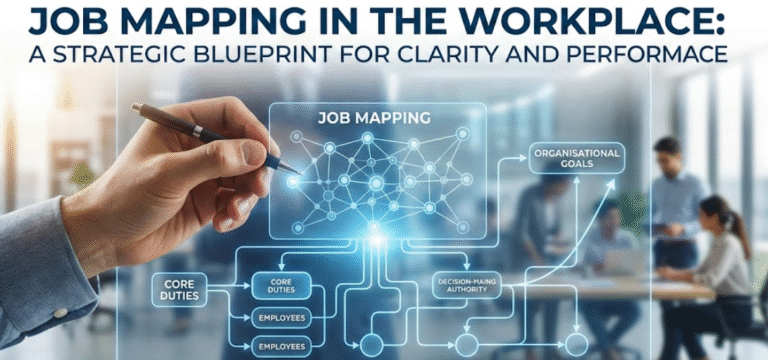
A comprehensive job map normally includes several elements. Core duties describe the main functions that define the role. Supporting tasks capture the additional activities that keep the workflow moving. Required skills highlight both technical and behavioural competencies needed for effective performance. Decision-making authority outlines what the role can approve or decide on independently. Workflow connections show who the job interacts with daily, such as internal departments, external stakeholders or customers. Taken together, these components show the real structure of the job beyond the formal job title.
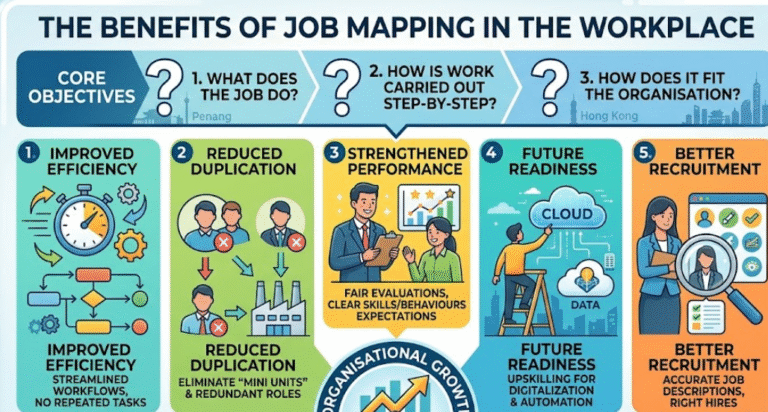
Job mapping essentially answers three critical questions:
- What does this job do on a practical and strategic level?
- How is the work carried out, step by step?
- How does this job fit into the larger organisational system?
These questions help uncover how work is truly performed rather than how the organisation assumes it is performed. This is especially important in Asian workplaces, where roles often evolve organically over time and employees may carry tasks beyond their official job descriptions. Across Asia, organisations use job mapping as a tool for clarity, efficiency and transformation. In Penang’s manufacturing sector, job mapping allows companies to compare the duties of line supervisors and spot unnecessary overlaps. This reduces redundancy and helps standardise production processes. In Hong Kong’s financial industry, job mapping is used to redesign customer service roles by analysing which tasks cause delays, which require approvals and which can be streamlined. This results in shorter turnaround times and more consistent customer experience.
In Indonesia’s fast-expanding logistics industry, job mapping helps organisations prepare for digitalisation and automation. By identifying which tasks are repetitive, which require judgment and which involve customer contact, leaders can decide which parts of the workflow can be automated and which require skill upgrading. This supports smoother technology integration and more efficient manpower allocation. In large Malaysian corporations and government-linked companies, job mapping is also used to support restructuring exercises. For example, during organisational transformation, leaders often discover that different departments perform similar administrative, procurement or customer service tasks. Job mapping provides evidence-based insights to combine, centralise or streamline these functions.
Overall, job mapping is not just a technical HR exercise. It is a strategic process that helps organisations understand how work is truly done, eliminate inefficiencies, strengthen accountability and build a workforce that is aligned with organisational goals. It provides leaders with a clear view of where improvements are needed and equips employees with a better understanding of their roles and contributions.
Why Job Mapping Is Important in the Workplace
Why job mapping matters
Job mapping provides the foundation for a well-organised workplace. When roles are unclear, even capable employees may struggle because they are unsure of their boundaries, priorities or responsibilities. Confusion leads to duplicated work, missed tasks, conflict between departments and wasted resources. Job mapping prevents these issues by making responsibilities visible and structured. It shows exactly who is responsible for each task, how the workflow moves across departments and where decisions should be made. This clarity builds a healthier, more coordinated workplace.
Improving efficiency and eliminating duplication
One of the most immediate benefits of job mapping is the improvement in operational efficiency. By breaking down each task within a role, organisations often discover repeated work or unnecessary steps that slow down processes. This is particularly common in large organisations where different units may unknowingly handle similar administrative, procurement or reporting functions. In Malaysian government-linked companies, for example, job mapping has been used during restructuring exercises to eliminate “mini units.” These are small departmental clusters performing tasks such as HR administration, procurement or customer service even though those functions should belong to centralised support divisions. Removing these overlaps allows the organisation to use its manpower more effectively and reduce internal confusion.

Strengthening performance management
Clear expectations lead to fair and effective performance management. When a job is mapped, employees understand not only what they must do but also which skills and behaviours are expected from them. This helps them focus their efforts and align their performance with organisational goals. Supervisors also benefit because job mapping provides a clear reference for coaching, performance reviews and accountability. Instead of relying on assumptions, managers can evaluate performance based on the exact tasks and outcomes defined in the job map. This reduces bias, strengthens communication and encourages continuous improvement.
Enhancing workforce planning and future readiness
Job mapping plays a crucial role in manpower planning. It reveals which roles are essential, which can be merged, and which may require new competencies. This is especially important as many Asian organisations undergo digital transformation. For instance, a major e-commerce company in Singapore used job mapping to identify positions that required stronger data skills. Once these needs were identified, the company introduced targeted reskilling and upskilling programmes to prepare staff for new digital tools. Without job mapping, these insights would remain hidden, leading to skill gaps and operational inefficiencies.
Supporting better recruitment practices
Recruitment becomes more accurate and effective when guided by a detailed job map. Many hiring issues arise because the job description does not match the actual work performed. When expectations are unclear, HR may select candidates who appear suitable but lack essential skills for the role. With job mapping, the organisation gains a realistic picture of the tasks, decisions and skills required. This helps HR create clear job advertisements, shortlisting criteria and interview questions. As a result, new hires are more aligned with actual job demands, reducing turnover and lowering long-term training costs.
Building accountability and strengthening teamwork
Clarity in roles naturally increases accountability. When workflow ownership is clearly mapped, employees know what they are responsible for and which tasks they must deliver. This reduces confusion, conflict and the tendency to pass responsibility to others. In industries such as banking, manufacturing and logistics, accountability is especially important for safety, compliance and accuracy. A mapped workflow helps prevent errors and improves coordination between teams. For example, in a logistics company in Indonesia, job mapping revealed unclear handover points between warehouse staff and delivery drivers. Once roles were mapped and clarified, delays and disputes significantly decreased.
Preparing organisations for long-term growth
Job mapping does more than solve current problems. It helps an organisation anticipate future needs, adapt to new technologies, and build a workforce that is ready for change. It supports continuous improvement, sharper decision-making and a more disciplined organisational culture. Overall, job mapping strengthens operational foundations, enhances talent management and prepares the organisation for growth. It creates a workplace where employees understand their purpose, supervisors lead more effectively and the organisation operates with clarity and confidence.