
Why Organisations Need More Than Ordinary Assessment Centres
Most organisations do not suffer from a lack of people. They suffer from a lack of clarity about people. They promote high performers into unsuitable leadership roles, select candidates based on interviews that are too subjective, and design succession plans without knowing whether the next layer of talent can actually think, decide, lead, communicate and execute under pressure.
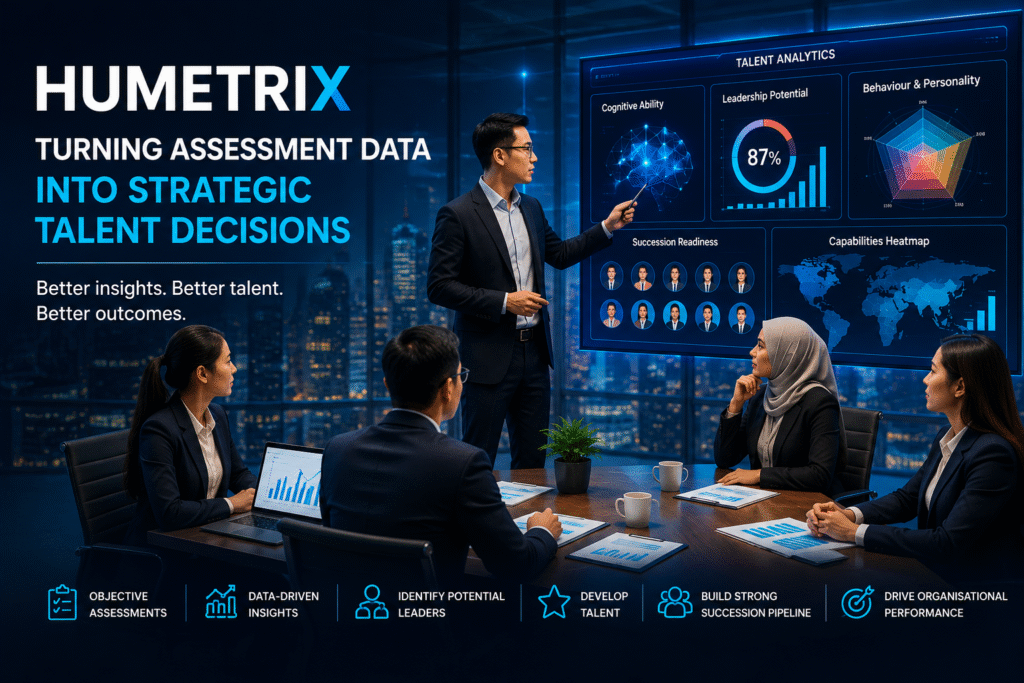
This is where Humetrix becomes strategically useful. Humetrix is not positioned merely as a testing platform. It is designed as an integrated talent assessment and analytics solution that helps organisations understand the real potential, capability gaps, behavioural tendencies and role-fit of their people. The platform combines cognitive assessments, psychometric profiling, assessment centre evaluations and competency-job mapping to support more objective and evidence-based talent decisions.
For talent development and succession planning, this distinction matters. A normal assessment centre often tells management who performed well during one event. Humetrix goes further by helping organisations answer deeper questions such as who is ready now, who has future leadership potential, who needs structured development, who fits a particular role and where leadership pipelines may be weak.
A Comprehensive Talent Assessment Ecosystem
Humetrix provides a broad assessment ecosystem that covers cognitive ability, critical thinking, workplace judgement, behavioural profiling, assessment centre evaluation and competency-job fit. Rather than relying on a single assessment methodology, the platform combines multiple evidence sources to create a more complete picture of talent readiness and organisational capability.
The assessment suite includes cognitive ability assessments that measure how individuals analyse information, solve problems and process complexity. It also incorporates critical thinking assessments that evaluate how effectively people assess evidence, challenge assumptions and arrive at defensible conclusions. Alongside these are numerical, verbal, logical, deductive, inductive, diagrammatic and spatial reasoning assessments that help organisations understand how individuals process information and make decisions.
Humetrix also evaluates situational judgement, an area that is particularly important for leadership and succession planning. Leadership is rarely tested through intelligence alone. Effective leaders must demonstrate sound judgement when dealing with uncertainty, competing priorities, stakeholder expectations and ethical dilemmas. The platform therefore incorporates assessments that examine decision-making, interpersonal effectiveness, time management and professional conduct.
To simulate real workplace demands, Humetrix includes In-Tray and E-Tray assessments that expose participants to emails, operational challenges, stakeholder requests and competing deadlines. These simulations provide valuable insights into managerial readiness and the ability to prioritise, delegate and make decisions under pressure. Error-checking assessments further strengthen the evaluation process by measuring attention to detail, compliance awareness and accuracy, which are critical for functions involving governance, regulation, finance and risk management.
The platform is further enhanced through psychometric profiling, assessment centre evaluations and competency-job mapping. These components provide insights into personality, motivation, leadership style, communication capability, teamwork and organisational fit. By linking assessment outcomes directly to job requirements, promotion readiness and succession planning needs, organisations can make talent decisions with greater confidence and precision.

Why Humetrix Stands Out
One of Humetrix’s greatest strengths is its ability to move beyond event-based assessment. Many assessment centres operate as one-off exercises that generate reports but provide little long-term value for workforce planning and talent development. Humetrix takes a different approach by integrating assessment, analytics, competency mapping and development planning into a single talent intelligence framework.
Its multi-method assessment approach combines cognitive reasoning, psychometric profiling, assessment centre evaluation, competency mapping and talent analytics. This provides a more complete understanding of individual capability because no single assessment can fully explain a person’s readiness for future responsibilities.
Another key advantage is its competency-based methodology. Rather than relying solely on qualifications, grades or years of service, Humetrix evaluates whether individuals can actually demonstrate the competencies required for success in a role. This shifts talent discussions away from seniority and towards evidence-based capability assessment.
The platform also supports customised assessments tailored to specific organisational contexts. This flexibility is particularly valuable because the leadership requirements of a regulator, manufacturer, government agency or professional services firm are rarely identical. Talent analytics further enhances decision-making by helping organisations identify capability gaps, succession risks, promotion risks and future development priorities.
Supporting Talent Development and Succession Planning
For talent development, Humetrix functions as a diagnostic engine that helps organisations understand the specific development needs of each individual. Rather than sending all employees through the same training programmes, organisations can develop targeted interventions based on cognitive capability, behavioural profile, leadership readiness and competency requirements. This improves both development effectiveness and return on training investment.
For succession planning, Humetrix helps organisations move beyond subjective decisions based on confidence, visibility or seniority. It provides a structured basis for identifying ready-now successors, future leaders, specialist talent pathways and employees who may require further development before assuming larger responsibilities. This reduces succession risk and strengthens leadership continuity across the organisation.
Conclusion
Humetrix should not be viewed merely as a testing platform. It is a talent intelligence platform that enables organisations to make more informed decisions regarding hiring, promotion, development, succession planning and workforce optimisation. By combining cognitive evidence, behavioural insights, competency mapping, assessment centre observations and talent analytics, Humetrix helps organisations build stronger leadership pipelines and make more confident talent decisions. For organisations seeking long-term organisational performance and leadership sustainability, that difference is strategic rather than cosmetic.
